The Greatest Trades II

This post is not going to be about one great trade exactly, but about the history of accounting and how it lead to the rise of trading in general. We are fully aware that history of accounting is not the best way to start a post and might sound insufferably boring but, we promise, it’s not!
Accounting is nothing more than a system to record transactions between people. At any one point in time, humans were bartering or trading or engaging in large-scale commerce, and along the way systems were developed to describe and account for those transactions.
The book Evolution of Accounting to 1900 (released in 1933) traces some of these systems. The main thread, as anyone familiar with accounting can guess, is concerned with the development of double-entry bookkeeping.
But the road to double-entry begins much earlier than is commonly assumed, with the separation of economic transactions into its different effects.
Flow and Stock
An important distinction in accounting is knowing whether you are measuring an accumulation of something, or measuring its flow over a time period.
Think of a bathtub. The water currently in the tub is the stock of water that has accumulated there. The water entering through the tap and leaving through the drain are flows. The first is an amount measured at a particular moment (we have X amount as of now), the second measured over a period of time (we generated X amount over this period).
The Romans understood the importance of this concept. In Roman households, a transaction was first recorded as a flow (money coming in or going out) in the receipts-and-payments book, and then as a stock (in the form of cash, debts, or loans) in the master’s ledger.
A very simple example: a merchant who receives 100 denarii may have earned it from a sale, borrowed it from a banker, or collected an old debt. In each case the cash receipt looks identical (he receives 100), but the economics are very different.
It seems obvious now, but the idea to record every transaction in two different ways was groundbreaking. It planted the seed of the idea that the movement of money does not by itself tell us whether wealth has been created or destroyed.
Anyway, the Romans developed this pretty sophisticated framework but, because their accounts were concerned with the internal affairs of a household, there was never any explicit attempt to reconcile the two accounts so that they formed a closed system.
The Rise of True Double-Entry
Enter the merchants from the Renaissance.
The late middle ages saw an endless amount of Crusades, which moved hundreds of thousands of Europeans through the Mediterranean, all spoiling for a fight. The cities in northern Italy that earned money transporting and supplying them flourished.
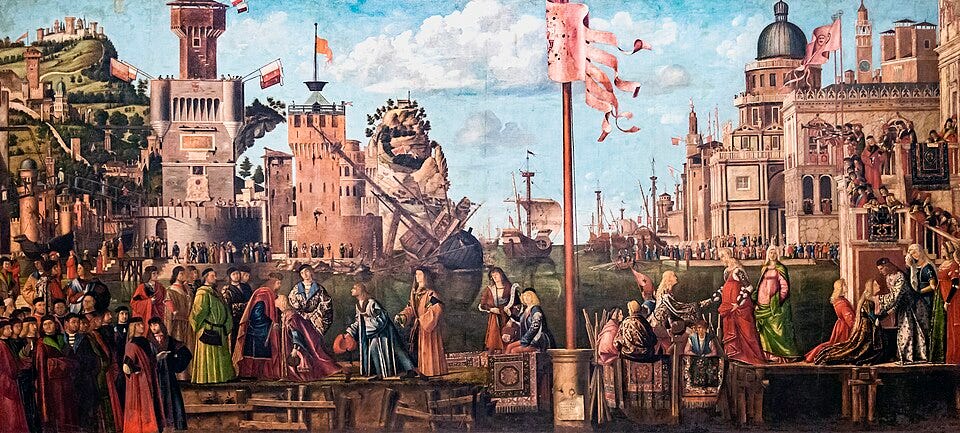
But what those same crusaders did, on their return home, was to bring with them a taste for Eastern products like spices and silks and introduce them to the European palate. Suddenly, consumer demand was awakened.
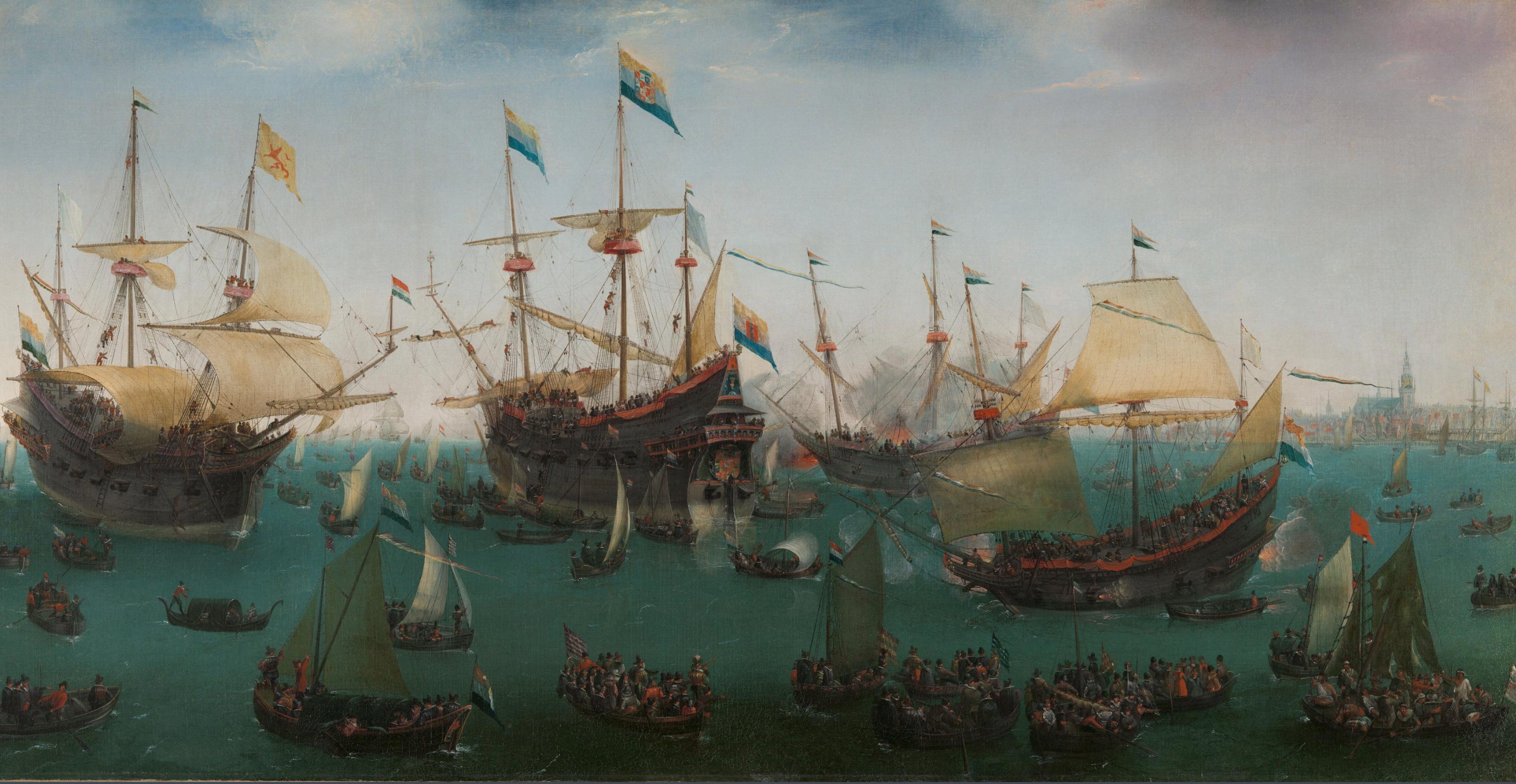
So now we had a continent with an appetite for new things. And meeting that demand required a great expansion of the supply chain, since ships had to be outfitted in advance, crews hired, etc. Months might pass before the goods returned and could be sold.
In short, what was needed were new investors willing to put up capital to finance these ventures; investors willing to risk their wealth in pursuit of a satisfactory return.
Whereas in ancient times wealth was often tied to land or used to build grand displays of power or status, suddenly in the Italian trading cities the financing of commerce became a regular and organized activity. Wealth could be pooled, entrusted to a merchant, sent abroad, returned with a profit, and then reinvested in another voyage.
The idea of the modern corporation was born.
Growing a Business
Learning about the evolution of the concept of flow and stock is important for us today, since any company can be understood as a stock of capital that is organized to produce future flows.
But what is the true distinction between flow and stock? Why does our accounting system treat certain costs as expenses (flows on an income statement) while others are capitalized (stock on the balance sheet)? What does the difference ultimately mean?
In order to grow, a company has to make basically three kinds of investments. It has to (1) hire more people (2) buy more land or equipment (3) buy more raw materials. Or any combination thereof.
For example, a farm that wants to grow must add some combination of people, productive assets, and raw materials. The same is true of every company to some extent, though the proportions vary. Let’s look at two companies in our portfolio: Greggs’ and Allison Transmission. Both have different investment profiles.
Greggs grows mostly by hiring people to staff new shops (number 1 in the list above). Allison’s growth requires more investment in equipment (2), as well as more cash tied up in working capital (3).
All three forms of growth consume cash today in the expectation of generating more cash tomorrow. The question then is: why does (1) get expensed but (2) and (3) get capitalized?
What essentially distinguishes equipment and working capital from labor?
The Evolution of Accounting to 1900 locates the answer in the idea of proprietorship. And this shift in thinking is really what leads to the great revolution in accounting, and the birth of large-scale commerce.
We have to remember that all accounting is just a convention. It is not necessarily the last word on economic truth. It is merely a system created by humans in pursuit of a goal.
And so what was that goal? In order to finance the ventures that would supply Europe with consumer goods in the late Middle Ages, financiers needed more than a record of cash received and cash paid. They needed a record of what they owned.
And since ownership is intrinsically bound up with the idea of control (and vice-versa), an expense becomes a capitalized asset only if it leaves investors in control of something of value. If that remaining value can still be used, the cost is carried forward on the balance sheet. If the value has already been consumed, nothing remains to claim and the cost becomes an expense.
Money spent on equipment remains embodied in a machine that can continue producing for years. Money committed to working capital remains embodied in inventory or receivables. The proprietor still has a claim upon an identifiable resource.
Labor is different because it is purchased as a service and consumed as it is performed. At the end of a worker’s shift, the company has no unused portion of that day’s labor left to carry forward and no claim upon the worker’s future service without paying again. The wage therefore passes immediately through the accounts as a flow of expense.
The implications of this may appear simple but, in our view, they are profound.
A labor-intensive business effectively rents productive capacity one shift at a time. Growth, therefore, is almost “self-funding”. A capital-intensive business on the other hand buys years of productive capacity in advance. It is a long-term investment. Indeed, Buffett has sometimes called large depreciation charges a type of “reverse float.”
So, is one dollar “better” invested in the company with higher labor costs, than one with higher capital costs? Not necessarily, because it all comes down to the price that is paid. But because the difference is essentially one of timing, the risks are also very different. Longer-duration assets are of course more exposed to longer-duration risks.
In the end, two companies making economically similar investments in future growth may report very different profits and very different amounts of invested capital. This is why return on capital cannot be read mechanically from the financial statements.
Before deciding that one company uses capital more efficiently than another, the analyst must reconstruct the timing of the underlying cash commitments. How much cash had to be advanced before additional revenue appeared? How much future profit will it generate? And how much of that investment can ultimately be recovered?
The answers determine the true price of growth.
All materials produced by Reveles Research, LLC—whether posted on this site or distributed elsewhere—are supplied solely for information and education. Nothing herein constitutes, or should be construed as, investment, legal, or other professional advice. You should carry out your own analysis and due diligence before acting. Every investment decision ought to reflect your unique financial circumstances, objectives, and tolerance for risk.